Child-centered play therapists are trained to use tracking statements to follow a child’s play and reflect their actions in the moment. Tracking communicates presence and acceptance while helping children become aware of their own choices and behaviors.
Another communication approach that can complement this work is declarative language, described in the work of Linda K. Murphy.
Declarative language is especially helpful for children who struggle with social referencing, perspective taking, or flexible thinking. Rather than directing behavior, asking questions, or correcting the child, declarative statements share observations about what can be noticed in the moment. This invites children into shared observation and curiosity, allowing them to draw their own conclusions about what is happening.
Declarative language and play therapy tracking share a common foundation: noticing without directing.
Tracking statements help children become aware of their own actions and experiences. Declarative language often expands the observation to include context, relationships, and perspective.
Using declarative language in CCPT can help children increase their awareness of:
- what others might see
- what is happening in the environment
- how actions affect the situation around them
Declarative language can also become a practical communication tool for parents and caregivers who want to increase awareness and connection without relying on questions or commands.
Examples in the Playroom
| Situation | Tracking Statement (Self-Awareness) | Declarative Language (Context/Perspective) |
|---|---|---|
|
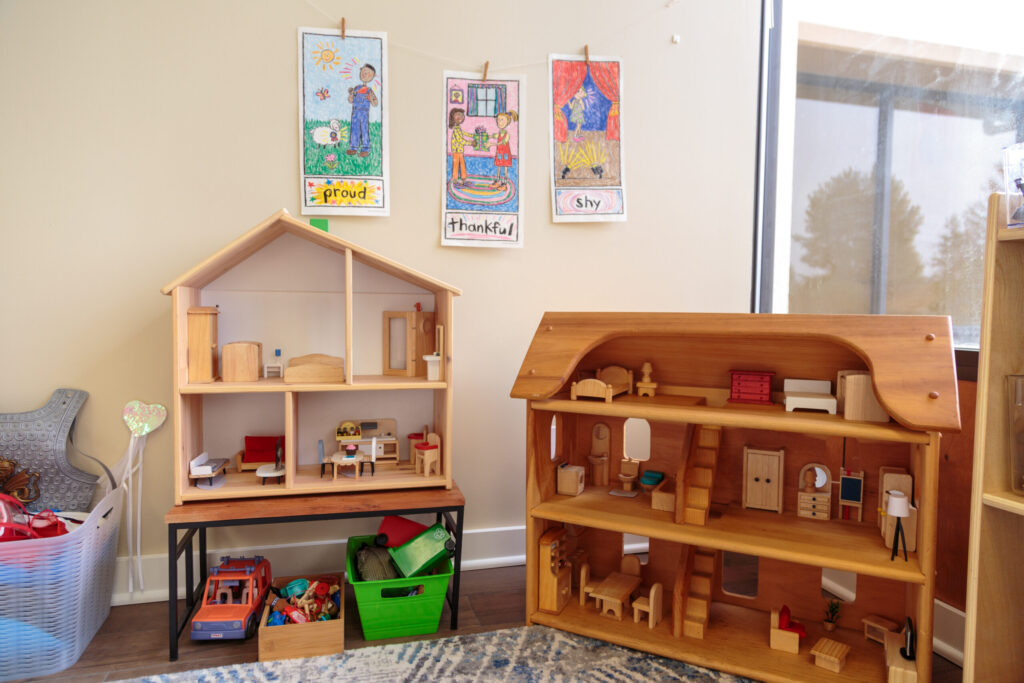
Child hides a figure behind the dollhouse |
“You put the figure behind the house.” |
“Now I can barely see him.” |
|
Child places two animals face to face |
“You put them right in front of each other.” |
“They’re looking at each other.” |
|
Child hides a tiger behind a rock |
“You hid the tiger behind the rock.” |
“The tiger is hard to see back there.” |
|
Child struggles with a toy |
“You’re trying to get it to work.” |
“That one is tricky.” |
|
Child looks at therapist after doing something |
“You’re looking at me.” |
“You’re checking to see what I noticed.” |
Notice how the shift changes the focus of attention:
- Tracking draws attention to the child’s behavior.
- Declarative language draws attention to what can be noticed in the environment or between people.
Both maintain a non-directive stance, but they highlight different pieces of information.
Over time, this kind of shared noticing can support developmental skills such as:
- visual referencing
- perspective taking
- social awareness
- flexible thinking
Implications for Play Therapy Documentation (CCD)
From a documentation perspective, this adds another way of describing what we are doing in the interventions section of the progress note.
Examples may include:
- Therapist provided declarative language statements to enhance contextual reference cues in play.
- Therapist used declarative language to support shared attention.
- Therapist amplified observable elements of the play scene to support noticing, shared attention, and perspective taking.
Sharing Declarative Language with Caregivers
Many parents naturally default to questions or directives, such as:
- “What are you doing?”
- “Stop that.”
- “Why did you do that?”
Declarative language offers a different approach.
Instead of asking or correcting, caregivers can share what they notice.
| Directive | Declarative Alternative |
|---|---|
|
“Stop that.” |
“That toy just flew across the room.” |
|
“Why did you do that?” |
“That was a big crash.” |
When caregivers begin noticing the environment and the child’s perspective, it naturally builds connection and shared attention.
This kind of communication often supports internal learning rather than compliance, helping children develop awareness, perspective, and problem-solving skills over time.
To explore more ways to document child-centered play therapy interventions, see Play Therapy Documentation Essentials: A Child-Centered Approach to Case Conceptualization and Treatment Planning.